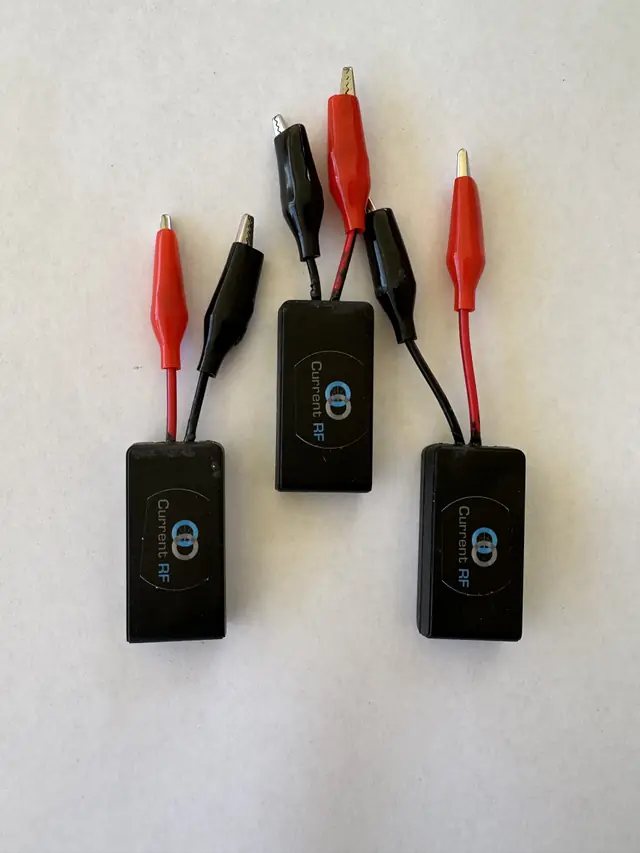
A clip-on module that eases the load on the alternator
The Current RF Mileage Booster connects across the battery terminals of a gasoline, diesel or hybrid vehicle. Current RF reports a 10% average driving range increase in its own testing. This page explains the mechanism and the test it cites.
Clip it across the battery
Current RF describes electrical noise as present in every electrical system. It names that noise as a contributor to reduced range in electric vehicles and to reduced fuel mileage in gasoline, diesel and hybrid vehicles. The Mileage Booster is the company’s answer for the vehicles already on the road.
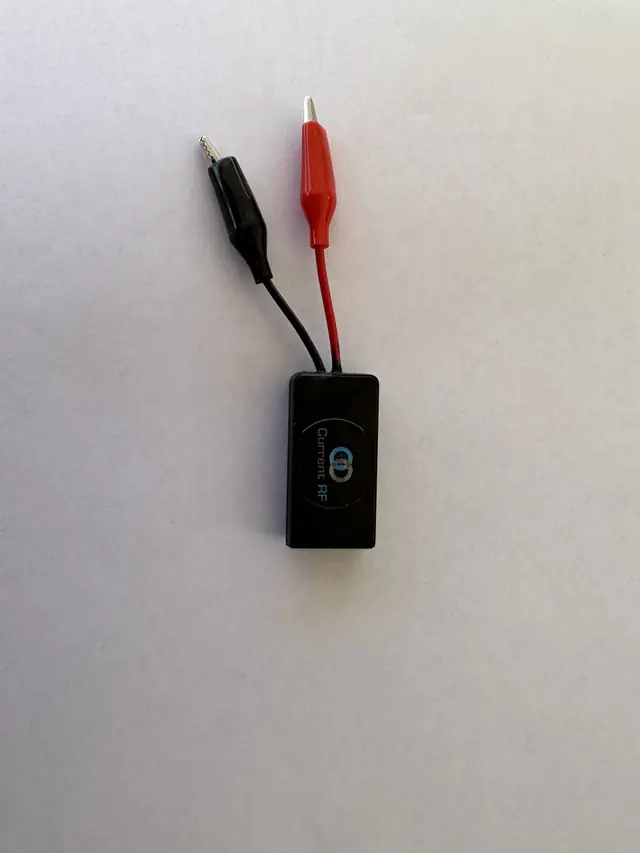
It attaches across the battery terminals. In the company’s own words, that is “much like one would install vehicle jumper cables (anyone can do it).” There is no wiring job and no inverter to open, which is what separates it from the EV Mileage Booster, a ground-side power-electronics part for EV and FCEV designers.
Current RF claims the booster increases fuel mileage by 10%, and frames that as roughly an extra gallon for free at each tank fill-up. Those are the company’s figures. The module is $59.99 on the ICE, diesel and hybrid product page.
The alternator mechanism, as Current RF explains it
Per Current RF, the module recycles electrical noise in the system and prevents deep discharge of the 12V battery. A battery that discharges less needs a smaller recharge current from the alternator stator coil.
The chain that follows is the company’s explanation. The alternator regulator senses the terminal voltage drop caused by the vehicle’s electrical demand, such as spark plug ignition and system current drain. With less of a drop to sense, it sends less current to the rotor field coil. The field coil then makes less magnetic flux, the stator coil outputs less current, and the alternator produces less back torque.
Less back torque is a lighter mechanical load on the engine, and Current RF attributes the improved miles per gallon to that lighter load. The same explanation is given for diesel engines and for the gasoline engine in a hybrid. On the electric side of a hybrid, the company describes its CC-100 IC in the ground lead of the DC-Link capacitor and reports a 10% hybrid range extension from that. The company’s published documents are listed on the datasheets page.
The Utah Salt Flats test
Current RF says it tested the ICE Mileage Booster on the Salt Flats in Utah before offering it to the public. The published result chart covers six trials, run with and without the module.
The headline lines in the company’s chart read: 3 miles per gallon average increase in mileage, a 36 mile average driving range increase per 12 gallon tank of fuel, and a 10% average driving range increase. The numbers hang together: 3 miles per gallon across a 12 gallon tank is 36 miles.
Read them as a manufacturer’s test, not as an independent road trial. The page text does not state vehicle make, load or speed, so ask Current RF for the test conditions through the contact form if you need to compare them with your own vehicle.
- Average mileage increase
- 3 MPG
- Company testing, Utah Salt Flats, 6 trials
- Range gain per 12 gal tank
- 36 miles
- Company testing, Utah Salt Flats, 6 trials
- Average driving range increase
- 10%
- Company testing, Utah Salt Flats, 6 trials
- Trials
- 6, with and without
- Company testing, Utah Salt Flats, 6 trials
Installation
The company’s product copy reduces installation to one action: clip the Mileage Booster across the battery terminals. The copy lists no further steps, and Current RF publishes two videos on the module, one on installation and one on benefits. Watch them on the videos page before you fit one.
Standard practice for any clip-on lead applies as well. These points are generic good practice, not steps taken from the company’s documents. Switch the engine off. Put the red clip on the positive terminal and the black clip on the negative terminal. Keep the leads clear of belts, fans and hot parts when you close the hood.
That is the whole job. If you want to compare the clip-on unit with the EV part, or buy a module, the shop lists both at $59.99 each, and the electric vehicles page explains the ground-side part.