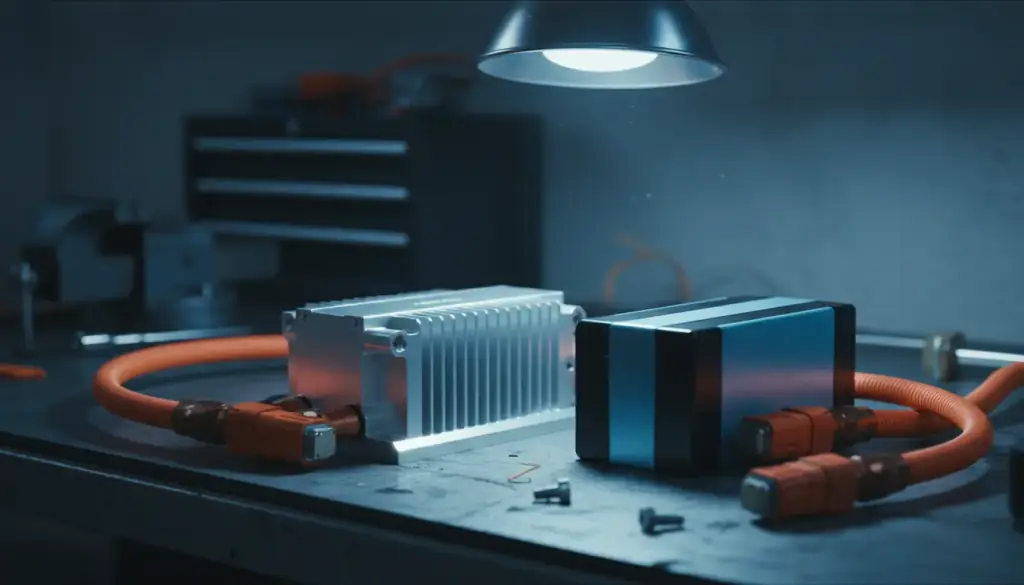
Recycle the DC-Link impulse current, extend EV range
Current RF reports that its CC-100 technology, placed on the ground side of an EV or FCEV DC-Link capacitor, saves about 10% of battery charge. This page covers the mechanism, the published schematic, the module and IP routes, and the datasheets.
- EV and FCEV driving range
- +10%
- Company-reported
- Battery charge saved
- 10%
- Company-reported
- CC-100 die
- 1.4 x 1.4 mm
- Current RF EV page
- Placement
- Series, ground
- Ground terminal of DC-Link / reservoir capacitors
- EV Mileage Booster module
- $59.99
- Current RF shop, per module
The DC-Link problem
An EV traction inverter is a noisy machine. Its power cables are shielded, because an unshielded EV would be heard by RF receivers from miles away and run into FCC interference limits. Current RF describes the contained noise as a design cost: DC-Link reservoir capacitors have to shunt this high frequency noise away from the battery and the inverter supply line.
That shunting is not free. Every impulse pulls the capacitor down and the battery recharges it. Current RF states that this action consumes battery current and so decreases driving range. The deeper the discharge of the DC-Link capacitor, the larger the recharge current the battery has to supply.
Current RF also points out how hard range is to win by conventional means. In the company’s words, most EV manufacturers struggle to get a 1% to 2% driving range increase and spend millions of dollars in the effort. Its claim is 10% from a part that costs a few dollars. That figure is the company’s own and has not been verified by an outside lab.
How the CC-100 harvests the impulse
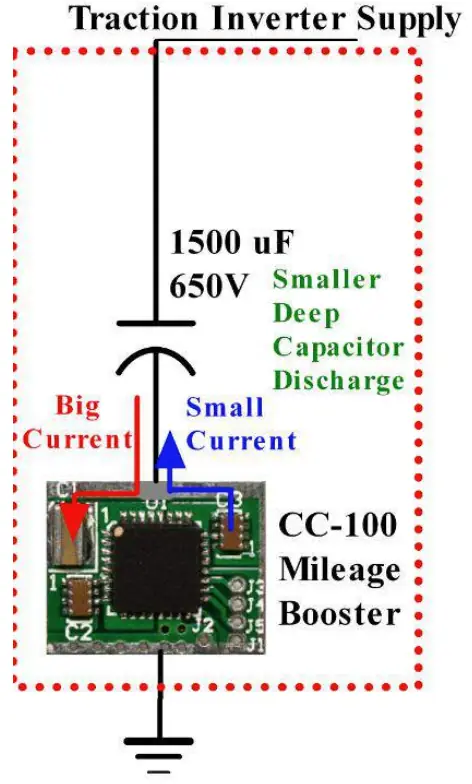
The CC-100 sits in series with the ground lead of the DC-Link capacitor. The impulse current that would flow out of the capacitor to ground passes through it instead. The device harvests that current and inverts it, a phase shift of 180 degrees, then feeds a portion of it back to its own input.
The fed-back portion partially cancels the original impulse. Per Current RF, the result is a lessened deep discharge of the DC-Link capacitor, and so less recharge current drawn from the EV battery. Less battery current for the same drive is what the company means by extended range and reduced range anxiety.
The same mechanism is described for fuel-cell EVs, where the company says it also reduces fuel use. For high-voltage cables, Current RF describes inserting the CC-100 in series between a cable shield or shield clamp and system ground, with the shield acting as a high-voltage capacitor. The shield clamp note covers that case.
Module or IP: who installs it
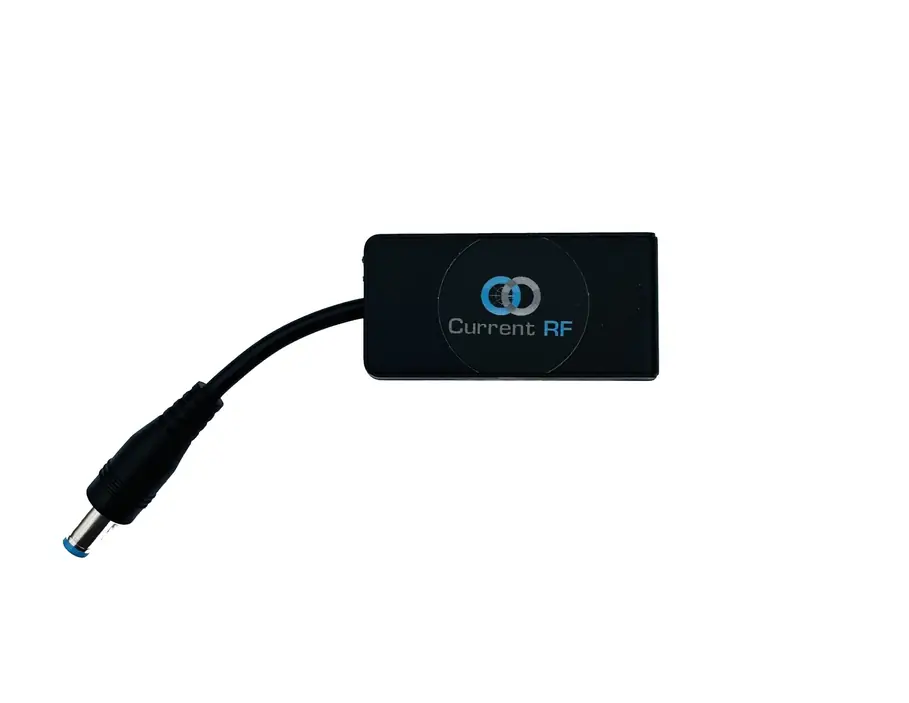
This is a power-electronics design-in, not a plug-and-play accessory. The EV Mileage Booster module goes in series with the ground terminal of the DC-Link capacitors, which means working inside the vehicle’s power electronics. It is a job for the engineer who owns the inverter, not for a driver in a parking lot. The clip-on unit on the ICE, diesel and hybrid page is a different product for a different installer.
Teams that want it inside their own hardware have two other routes. The CC-100 IC is available on request. The same circuit is offered as licensable IP, CC-100IP-MB, for a Mileage Booster function inside your own silicon. The CC-100IP-MB datasheet describes that IP, and Current RF also lists the PowerPad for the same ground-side placement.
The module is listed on the EV Mileage Booster product page at $59.99. Prices for the IC, the IP and evaluation boards are on request. Ask for an evaluation board through the contact form, and read the datasheet before you ask.
Documents to read first
Every number on this page traces to a Current RF document. The ledger lists the CC-100IP-MB datasheet and the CC-100 IC documents, including the fuel-cell EV note. They open as PDFs on currentrf.com.
The full register is on the datasheets page. Application notes for the ICE side of the same technology are on the ICE, diesel and hybrid page, and the shop is at /product/ev-mileage-booster.
- 01CC-100CC-100CC-100 Power Optimizer IC datasheet, rev 5IC · PDF
- 02CC-100CC-100CC-100 IC overviewIC · PDF
- 03CC-100CC-100CC-100 IC in fuel-cell EVsNote · PDF
- 04CC-100CC-100CC-100 IC shield clampsNote · PDF
- 05CC-100CCC-100CCC-100C insertionNote · PDF
- 06CC-100CC-100CC-100 IC design and characterizationNote · PDF