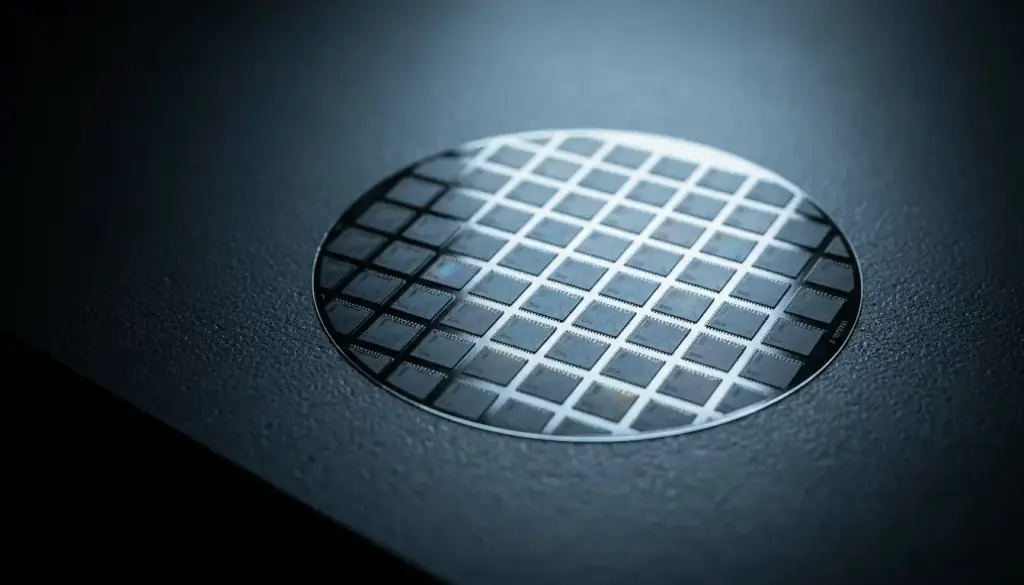
Recycle the dynamic current your IC throws away.
The CC-100 and its IP family capture impulse current on the power grid, invert it, and feed part of it back to cancel the original. Current RF reports up to 40% lower digital dynamic current. This page lists the parts, the mechanism, and what to ask for.
- Process
- GlobalFoundries CM018RF
- Products page
- CC-100 die
- 1.4 x 1.4 mm
- Electric Vehicles page
- Digital dynamic current
- up to 40% lower
- Company-reported, CC-100IP-RF
- Switching and dynamic power
- 20 to 40% lower
- Application note, autonomous-EV ICs
- Effective series inductance
- 25% lower
- PowerPad datasheet
- Reservoir capacitance
- up to 600X
- CC-100IP-RF datasheet
How the CC-100 harvests and recycles dynamic current
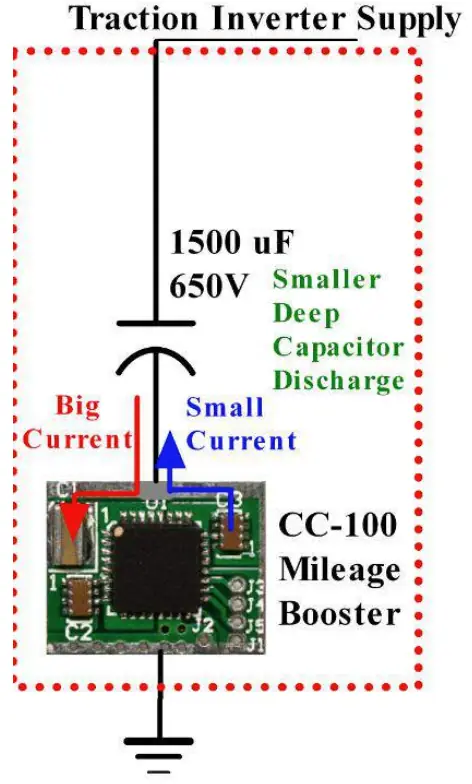
Every digital, RF and DC-Link power system sheds impulse current. A switching edge pulls a spike out of the reservoir capacitor, the spike flows to ground, and the supply then has to refill the capacitor. Current RF calls this thrown-away energy.
The CC-100 sits in the ground return of that path. It takes the noise and impulse current, inverts it by 180 degrees, and feeds a portion back to its own input. That cancels part of the original impulse. In Current RF testing the practical result is a shallower discharge of the reservoir capacitor and less recharge current drawn from the supply.
The same mechanism is built three ways. The CC-100 is a discrete IC produced on GlobalFoundries CM018RF and available on request. The CC-100 IP family puts the circuit on die. Current RF states the IP import is scalable across processes from 0.6 um to 28 nm, with the proof-of-concept silicon produced on CM018RF. Vehicle and USB modules use the discrete part; see electric vehicles for the DC-Link case.
The IP family: CC-100IP, PowerPad and PowerGrid
CC-100IP-RF is an on-chip RF and EMI reduction block for IC power grids. Current RF says it creates the lowest impedance point on the grid, which gives maximum on-chip supply filtering, with up to a 600X improvement in reservoir capacitance per the datasheet. Current RF also states it aids on-chip cybersecurity enhancements. See the cyber security page for the side-channel argument.
CC-100IP-PI is an adjustable, impedance-controlled Hypercapacitor. It offers capacitance multiplication and series inductance nullification, plus energy harvesting. CC-100IP-MB is the Mileage Booster IP for vehicle power electronics.
PowerPad replaces power and ground bondpads, so the IC area grows by almost nothing. Its reservoir capacitance is controlled by noise-activated input current. It can stand alone as an on-chip decoupling cell or run in parallel with existing DCAP structures, and its negative feedback gives the 25% ESL reduction Current RF reports. PowerGrid is a digital power-grid overlay. It reuses the top-level metal of the digital routing and makes a magnetic connection from the supply line, activated by the dynamic noise current at the Dvdd terminal.
- CC-100IP
- On-die current recycling
- CC-100IP datasheets
- CC-100IP-RF
- On-chip RF and EMI reduction
- CC-100IP-RF datasheet
- CC-100IP-PI
- Adjustable Hypercapacitor
- CC-100IP-PI datasheet
- CC-100IP-MB
- Mileage Booster IP
- CC-100IP-MB datasheet
- PowerPad
- Bondpad overlay
- PowerPad datasheet
- PowerGrid
- Digital power-grid overlay
- PowerGrid datasheet
How an engagement works
Current RF puts it plainly: “We can Power Analyze your ICs and systems and design or retrofit our IP into devices.” The first step is a look at where your design loses current to dynamic switching. That tells you whether PowerPad, PowerGrid or a CC-100IP block fits the floorplan and the process.
From there Current RF will supply evaluation boards and reference designs on request. The CC-100 demonstration board application note covers layout practice for getting the most out of the part on a PCB. Tell the team your process node, supply voltage and the noise you are fighting, and ask for the datasheet that matches.
If your target is RF rather than power, the amplifier, inductor and rectifier blocks are on the radio frequencies page. Every PDF below is published by Current RF and linked, not copied.
- Power analysis
- Your ICs and systems
- Retrofit
- Design our IP into your device
- Evaluation boards
- On request
- Reference designs
- On request
- IC, IP pricing
- On request
Datasheets and the autonomous-EV note
The register lists every IC and IP datasheet Current RF publishes. Open the one for your part, then use the full datasheet page for application notes on the CC-100 and its USB derivatives.
- 01CC-100CC-100CC-100 Power Optimizer IC datasheet, rev 5IC · PDF
- 02CC-100CC-100CC-100 IC overviewIC · PDF
- 03PowerPadPowerPadCurrentRF PowerPad datasheetIP · PDF
- 04PowerGridPowerGridCurrentRF PowerGrid datasheetIP · PDF
- 05CC-100IP-RFCC-100IP-RFCC-100IP-RF datasheet, rev 1IP · PDF
- 06CC-100IP-PICC-100IP-PICC-100IP-PI datasheet, rev 2IP · PDF
- 07CC-100IP-MBCC-100IP-MBCC-100IP-MB Mileage Booster IP datasheet, rev 2IP · PDF
One application note is worth reading first if you design for autonomous vehicles. It covers 20 to 40% switching and dynamic power reduction using a PowerGrid or a ground PowerPad modification, as reported by Current RF. It also bears on the electric vehicle work, where the same idea runs at the DC-Link.