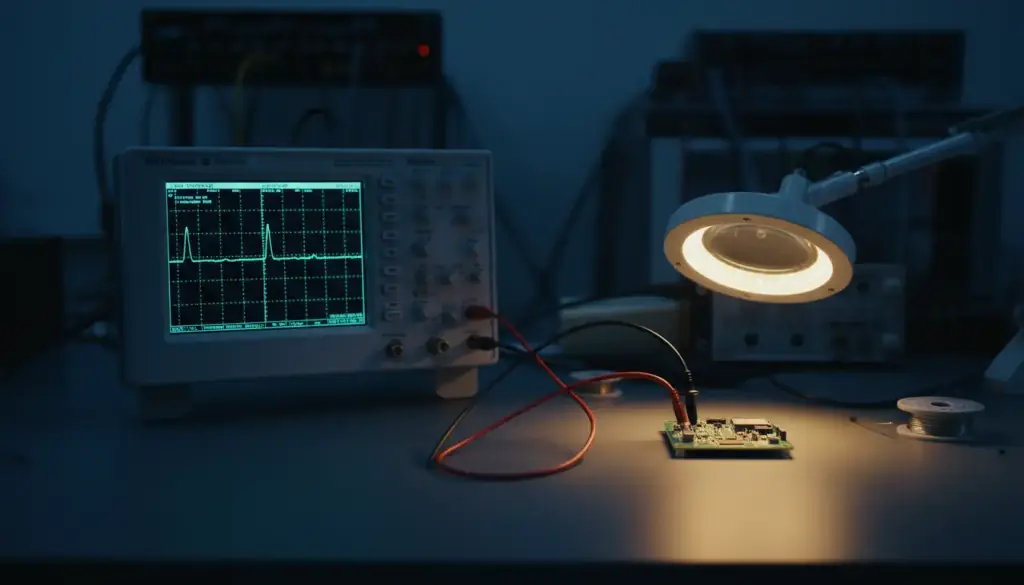
The USB port is also an RF port.
Servers and network devices radiate noise that couples onto the +5V line of their USB ports. Current RF built PowerStic and Exodus to capture that energy and recycle it, which the company says also denies an attacker a signal to read.
Why the USB port matters at RF
Most people treat USB as a digital data path and nothing else. Current RF looks at it differently. Ignore the data lines and look only at the +5V and ground pins, and the company says you will find a rich source of RF frequencies of significant magnitude. This matters more as USB 3 speeds make RF effects dominant.
Put an AC coupled spectrum analyzer of enough bandwidth on that supply and you see more than the spikes from data transfer. Current RF says you also see noise coupled in from the rest of the machine: processors, memory, graphics cards, drives, and network activity. In the company's phrase, the USB port becomes the “eyes into the system”.
Low dropout regulators and switch mode regulators are common in data-center and business equipment. Current RF states that they do little to contain processing and clock noise, because that noise is high enough in frequency to couple through almost unimpeded. Only a portion reaches the USB line, but it is a portion that sits on a connector people can touch.
Side-channel emissions and what the devices do about them
A side-channel attack does not break encryption directly. It reads something the hardware gives away while it works, such as emitted noise, and uses it to infer secrets. Current RF's page says a portion of the noise at the USB port can be picked up and used to reconstruct cipher keys and passwords. It points readers to a published article for the method.
Current RF describes PowerStic and Exodus as “active snubbers” for USB ports. They suppress and recycle energy that would otherwise be radiated, and the company says this denies an attacker access to it. The captured energy is fed back into the system, which lowers the load on the voltage regulators and the power drawn from the wall plug or battery.
Treat this as a design intent from the vendor, not a certified security control. If side-channel exposure is a real concern in your environment, measure it. That is what the testing offer below is for.
- Device role
- Active snubber
- Current RF, cyber security page
- Where it acts
- USB +5V and ground
- Energy handled
- Radiated RF noise
- Recycled into the system as power
- ROI, on average
- 3 to 10 months
- Company estimate
On-site testing, and the chip behind it
Current RF offers on-site testing for power and security. The company analyzes your systems with and without a PowerStic or Exodus device inserted, shows you the power and money you would save, and retrofits a device if you want one. Current RF says the result is a lower carbon footprint and data that is more secure at system endpoints. To arrange it, use the contact page.
The devices share their origin with the CC-100 Power Optimizer IC. At silicon level, Current RF offers the CC-100IP-RF, an IP block for on-chip RF and EMI reduction. It is a different product from the USB devices, aimed at chip designers. The radio frequencies page lists the RF IP parts and their datasheets.
Current RF gives an ROI range of 3 to 10 months on average, because the energy the devices recover is also power you no longer pay for. That figure is the company's own. The power case for servers, with the published app notes, is on the cloud computing page.