How DC-Link capacitor discharge wastes energy in an EV
The capacitor across an inverter's DC bus is small in the spec sheet and large in the energy story.
October 5, 2026 · 4 min read
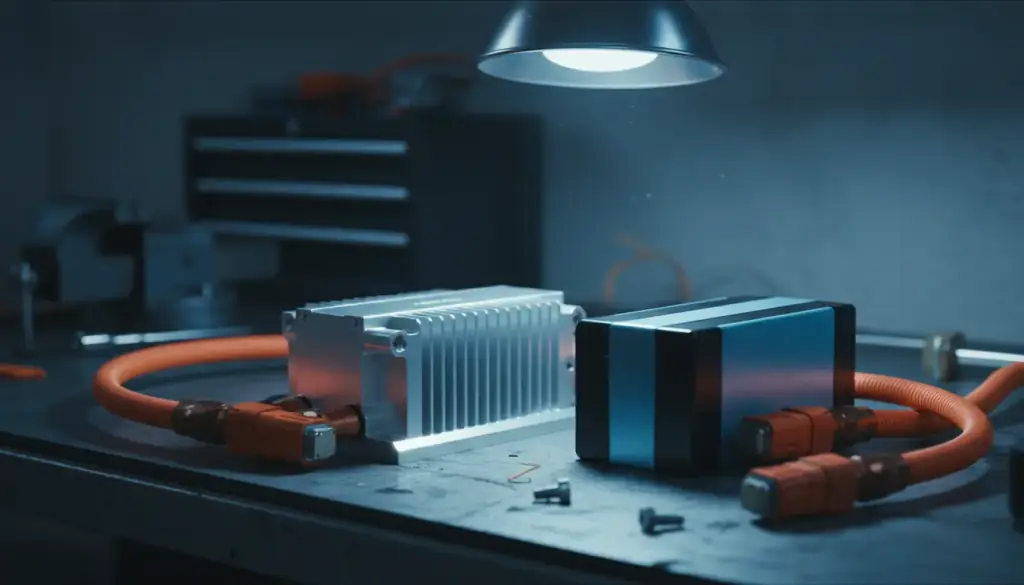
What a DC-Link capacitor does
A traction inverter does not draw current from the battery as a smooth stream. It switches the battery voltage into three-phase AC for the motor, and every switching event pulls a short burst of current. A large capacitor sits across the DC bus to supply those bursts locally. That capacitor is the DC-Link, also called the reservoir capacitor.
Without it, the battery and its cabling would see every pulse. Cable inductance turns fast current edges into voltage spikes, and those spikes stress the inverter switches. With the capacitor in place, it handles the fast part of the demand and the battery supplies the average.
The parts are not small. The schematic on the Current RF electric vehicle page shows a 1500 uF, 650 V DC-Link capacitor on a traction-inverter supply. Your platform will use different values, but the role is the same.
Why discharge and recharge cost energy
Each burst the inverter draws pulls the capacitor voltage down a little. Before the next burst, the battery has to push charge back in. That recharge current flows through the cable resistance, the battery's internal resistance, and the capacitor's own equivalent series resistance (ESR).
Power lost in a resistance scales with the square of the current. That is general circuit theory, not a claim about any product. A supply that swings the capacitor deeply and recovers it in sharp pulses loses more than one that swings it gently. Halve the peak current in a recharge pulse and the resistive loss in that pulse drops to a quarter.
Where the loss shows up on a real bus:
- Cable and busbar resistance, heated by the recharge pulses.
- Battery internal resistance, which rises as the pack gets cold or ages.
- Capacitor ESR, which turns ripple current into heat inside the part.
- Switching loss in the inverter, which depends partly on how clean the bus voltage stays.
Where the CC-100 Mileage Booster sits
Per Current RF, the EV Mileage Booster is a module wired in series with the ground terminal of the DC-Link capacitor. The company describes the CC-100 inside it as capturing impulse current that flows out of the capacitor toward ground. It inverts that current by 180 degrees and feeds a portion back to its input. The fed-back portion cancels part of the original impulse.
Current RF says the effect is less deep discharge of the DC-Link capacitor and less recharge current drawn from the battery. That is the company's description of the mechanism. It is a vendor explanation, so read it as a hypothesis to test on your own bus, not as a result you can assume.
What Current RF reports
Current RF reports that the module saves 10% of battery charge and so extends EV driving range by 10%. The company adds that most EV manufacturers struggle to get a 1% to 2% range increase. Those are the company's figures. The Current RF site does not show independent verification of them, and neither does this article.
The EV Mileage Booster is sold as a consumer module at $59.99. The same technology is also offered as IC and IP, with pricing on request.
How to test it on your own platform
A saving of a few percent is smaller than the normal spread you get from wind, temperature, traffic and tire pressure. So the test has to remove those variables. Work on a high-voltage bus belongs to qualified people following the right procedures. If that is not you, run the comparison with a bench inverter setup or with a vehicle that a qualified technician prepares.
- Fix the drive cycle. Use a dynamometer schedule or a closed loop you can repeat, at the same speeds.
- Record battery energy in and out, not just state of charge. State of charge readouts move in steps.
- Put a current probe on the capacitor ground lead and log ripple current with and without the module.
- Match pack temperature and ambient temperature between runs.
- Run at least three repeats of each configuration and compare the gap to the run-to-run spread.
If the difference between configurations is smaller than the spread between identical runs, you have not measured anything yet. If it is larger and holds across repeats, you have a real number for your platform.
What to ask before you buy
Ask which capacitor values and bus voltages the module was characterized on. Ask where in the bus it should be wired and what the lead lengths should be. Ask for the FCEV note if you run a fuel-cell vehicle, since Current RF publishes one. Those answers decide whether your bus resembles the one in the company's test.
The CC-100 datasheet and the FCEV note are listed on the Datasheets page, and the EV Mileage Booster is in the Shop.
Current RF, (209) 914-2305
Call (209) 914-2305More articles
Where dynamic power goes inside a digital IC
Dynamic power is the part of an IC's budget that scales with activity, and the supply network decides how much of it you waste.
Measuring server power savings before you buy
Any device that claims to cut server power should earn its place in a controlled test, and the test is cheap to run.